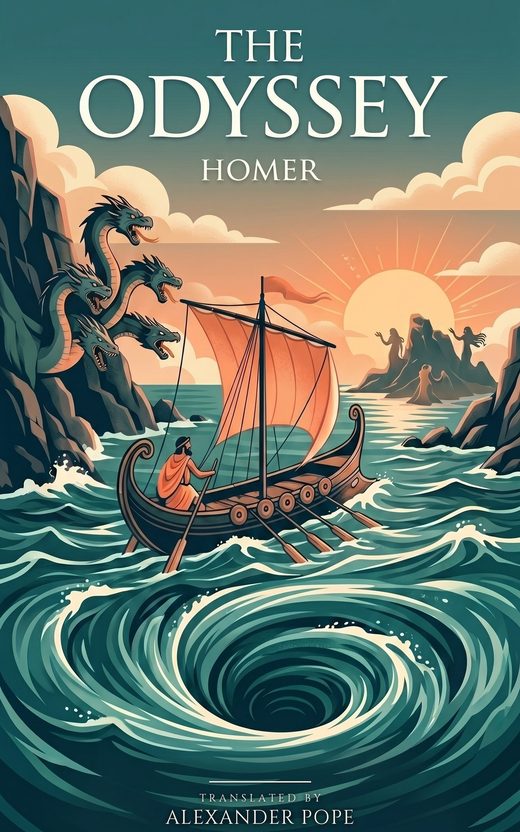
Alexander Pope's Odyssey
“The man for wisdom's various arts renown'd,
Long exercised in woes, O Muse! resound;”
About this edition
About This Translation
Alexander Pope (1688–1744) was the dominant English poet of his age and the acknowledged master of the heroic couplet. His Odyssey appeared in five volumes between 1725 and 1726, following the great success of his Iliad. As with the Iliad, Pope transformed Homer's unrhymed dactylic hexameter into heroic couplets — rhyming pairs of iambic pentameter lines.
The Age That Made It
Pope's Homer belongs to the Augustan moment in English letters, when balance, polish, and wit were prized and the couplet was the reigning poetic form. It was also a commercial landmark: the success of the Iliad is widely credited with making Pope the first English writer to achieve financial independence from his published work, largely through subscription sales. The Odyssey, however, carries a now-famous complication. Worn out by the labor, Pope quietly hired two collaborators — Elijah Fenton and William Broome — who between them translated twelve of the twenty-four books, with Broome also supplying the notes. Pope translated the other twelve and attempted to suppress the extent of the collaboration; when it became known it is generally said to have bruised his reputation without denting his profits.
What's Distinctive, and What's Contested
Pope's Odyssey is widely regarded as elegant and euphonious rather than literal — a version that keeps the spirit and grandeur of the epic while reshaping it to eighteenth-century taste. For generations it dominated the way English readers met Homer. Opinion has long been divided on the result: admirers find it majestic and superbly crafted, while critics from the Romantics onward have argued that the relentless polish of the couplets smooths away Homer's plainness and speed. Whether that is a loss or a transformation depends on what one wants a translation to preserve.
How This Version Reads
Expect stately, rhyming couplets and elevated eighteenth-century diction. The music is regular and the phrasing formal; the pleasures are those of craftsmanship and grandeur rather than directness. It reads beautifully aloud, but readers seeking Homer's blunt pace often find a modern version easier going.
Download this translation — free
Public domain · EPUB works on Kindle, Apple Books & Kobo. No registration.
EPUB opens in Apple Books, Kobo & most readers. For Kindle, use Amazon's free Send to Kindle — it accepts EPUB too.
At a glance
- Translator
- Alexander Pope (1688–1744)
- Published
- 1725–1726
- Form
- Heroic couplets (rhymed iambic pentameter)
- Reads like
- Grand, musical, formal — reads beautifully aloud
- Rights
- Public domain — free to download and keep
Compare other translations
Ready to read Alexander Pope?
Free public-domain download — EPUB works on Kindle, Apple Books & Kobo.