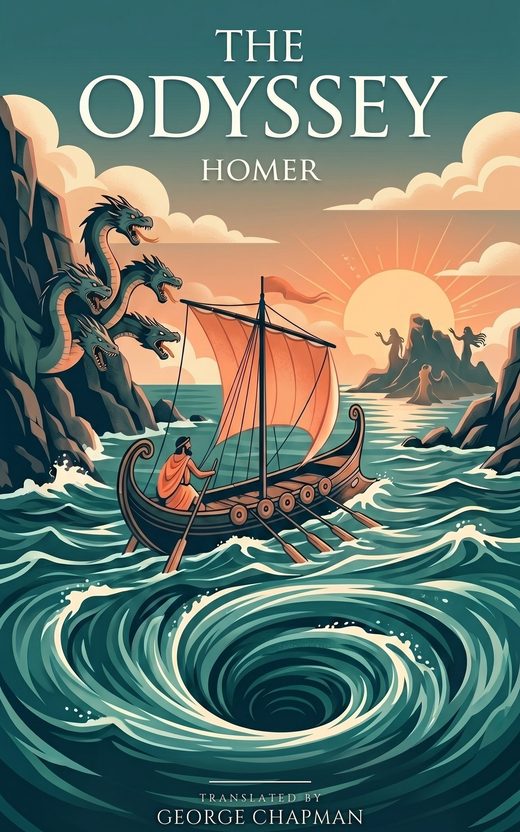
George Chapman's Odyssey
“The man, O Muse, inform, that many a way
Wound with his wisdom to his wished stay;”
About this edition
About This Translation
George Chapman (c. 1559–1634) was an English dramatist, poet, and classical scholar working in the London of Shakespeare and Ben Jonson. His translation of the Odyssey is generally recognized as the first complete English rendering of the poem. Having published his complete Iliad in 1611, he issued the Odyssey in two installments — Books 1–12 in 1614 and Books 13–24 in 1615 — before uniting them in the folio Whole Works of Homer around 1616. Where Homer's Greek used unrhymed dactylic hexameter, Chapman rendered the Odyssey in rhymed couplets of iambic pentameter. By his own account, he claimed to have been inspired by the ghost of Homer.
The Age That Made It
Chapman worked at the seam between the Elizabethan and Jacobean periods, drawing on the same linguistic energy that powered the era's drama. The work was a bid for survival as much as art: like many writers of the time, Chapman depended on aristocratic patronage, and the translation carries a dedication to Robert Carr, Earl of Somerset — a patron whose fall in a court scandal is generally cited as one of several financial blows Chapman suffered. His Homer is often described as shaped by a Christian and Stoic sensibility, with scholars frequently noting that his Odysseus reads less as a Greek hero than as a model of Christian endurance — a reminder that every translation carries the worldview of its moment.
What's Distinctive, and What's Contested
Chapman's version is among the most celebrated in English, though largely for its historical stature rather than its literal fidelity. John Keats famously immortalized it in his 1816 sonnet “On First Looking into Chapman's Homer,” and the Victorian critic George Saintsbury claimed it stood for centuries as the way English readers without Greek encountered Homer. Admirers such as Swinburne praised its grandeur and fire. But its reputation is genuinely divided: the same density, rhyme, and Elizabethan diction that thrill some readers are widely regarded as making it difficult and archaic for others. How one weighs this depends partly on what one believes a translation is for — an exact window onto the original, or an English poem in its own right.
How This Version Reads
Expect dense, ornamented, rhyme-driven verse in older spelling and syntax. It rewards patience and reading aloud, and is best approached as a Renaissance poem inspired by Homer rather than a transparent path to the Greek. Readers wanting a faster first encounter often begin elsewhere and come to Chapman for its language and its place in literary history.
Download this translation — free
Public domain · EPUB works on Kindle, Apple Books & Kobo. No registration.
EPUB opens in Apple Books, Kobo & most readers. For Kindle, use Amazon's free Send to Kindle — it accepts EPUB too.
At a glance
- Translator
- George Chapman (c. 1559–1634)
- Published
- 1614–1615
- Form
- Rhymed couplets (iambic pentameter)
- Reads like
- Dense Elizabethan verse for language-lovers
- Rights
- Public domain — free to download and keep
Compare other translations
Ready to read George Chapman?
Free public-domain download — EPUB works on Kindle, Apple Books & Kobo.