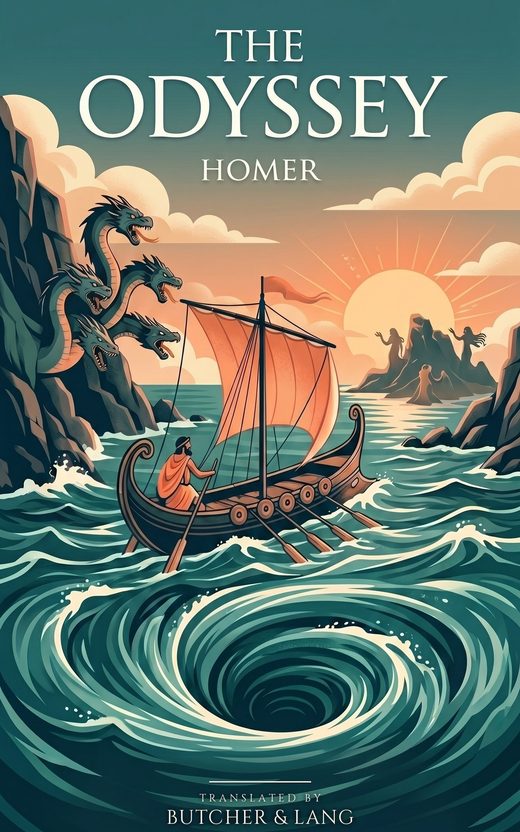
The Butcher & Lang Odyssey
“Tell me, Muse, of that man, so ready at need, who wandered far and wide, after he had sacked the sacred citadel of Troy.”
About this edition
About This Translation
This prose translation was the joint work of Samuel Henry Butcher (1850–1910), a Professor of Greek at Edinburgh, and Andrew Lang (1844–1912), the prolific Scottish author, folklorist, and man of letters. First published in 1879, it renders the Odyssey not as verse but as elevated English prose.
The Age That Made It
Butcher and Lang worked in the late Victorian period, when there was strong interest in presenting the classics to a broad, educated readership. They chose a deliberately archaic, elevated prose register — often described as “biblical” in flavor, echoing the cadences of the King James Bible — as a way of signaling the antiquity and dignity of the original. The approach reflects a Victorian conviction that an ancient epic should sound solemn and remote rather than colloquial.
What's Distinctive, and What's Contested
The translation was admired in its time and is still noted for the attractiveness of its language. Its defining feature — the consciously antique, scriptural prose — is also the main point of contention. Some readers find it stately and atmospheric; others find the deliberate archaism (“yea,” “thou,” and the like) a barrier rather than an aid. Whether the elevated style brings a reader closer to Homer or further from him is, in the end, a matter of taste and of what one thinks ancient poetry should sound like in English.
How This Version Reads
Expect flowing but deliberately old-fashioned prose, dignified and rhythmic. Because it is prose, it is easier to follow line-by-line than the verse translations, but the Victorian diction asks some patience. It suits readers who enjoy a stately, atmospheric telling over a brisk modern one.
Download this translation — free
Public domain · EPUB works on Kindle, Apple Books & Kobo. No registration.
EPUB opens in Apple Books, Kobo & most readers. For Kindle, use Amazon's free Send to Kindle — it accepts EPUB too.
At a glance
- Translator
- S. H. Butcher (1850–1910) & Andrew Lang (1844–1912)
- Published
- 1879
- Form
- Prose (elevated, “biblical”)
- Reads like
- Stately, atmospheric Victorian prose
- Rights
- Public domain — free to download and keep
Compare other translations
Ready to read Butcher & Lang?
Free public-domain download — EPUB works on Kindle, Apple Books & Kobo.