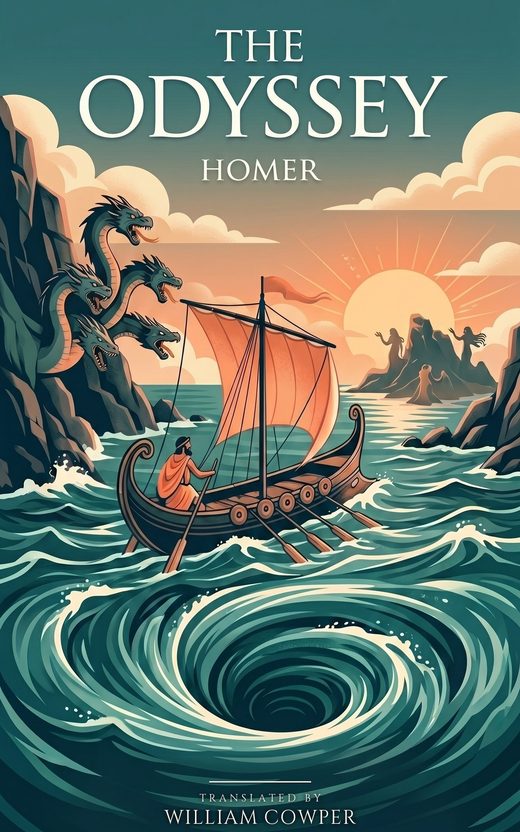
William Cowper's Odyssey
“Muse make the man thy theme, for shrewdness famed
And genius versatile, who far and wide
A wand'rer, after Ilium overthrown, discover'd various cities…”
About this edition
About This Translation
William Cowper (1731–1800) was one of the most popular English poets of the later eighteenth century and a noted hymn-writer. His complete translation of the Iliad and Odyssey was published in 1791. Unlike Pope, Cowper rendered Homer in blank verse — unrhymed iambic pentameter — explicitly modeled on the manner of John Milton.
The Age That Made It
Cowper undertook the work, by widely repeated account, out of dissatisfaction with the ornament and polish of Pope's hugely successful version. Where Pope had smoothed Homer into rhyming couplets, Cowper aimed for a plainer, more literal fidelity to the Greek, choosing Miltonic blank verse to carry what he saw as Homer's simple majesty. The result sits at a transition point in English taste, as the elaborate Augustan style began giving way to the plainer registers that Romantic and later poets would favor.
What's Distinctive, and What's Contested
Cowper's Odyssey is generally regarded as more faithful and closer to the original than Pope's, and is often praised for its dignity and “simple majesty.” The critic Matthew Arnold described it as conscientiously literal. Its reputation, though, is mixed: some readers and critics have found it stiff, and have argued that its heavy debt to Milton gives it a borrowed solemnity rather than Homer's own ease. As with every translation, the trade-off between fidelity and flow is partly a matter of what the reader values.
How This Version Reads
Expect grave, unrhymed blank verse with an audibly Miltonic cadence. It is plainer than Pope and more flowing than Chapman, but still formal and eighteenth-century in feel. It suits readers who want a faithful older verse rendering and don't mind a measured, stately pace.
Download this translation — free
Public domain · EPUB for Apple Books & Kobo, .azw3 for Kindle. No registration.
EPUB opens in Apple Books, Kobo & most readers. For Kindle, use Amazon's free Send to Kindle — it accepts EPUB too.
At a glance
- Translator
- William Cowper (1731–1800)
- Published
- 1791
- Form
- Blank verse (unrhymed iambic pentameter)
- Reads like
- Faithful, measured, Miltonic blank verse
- Rights
- Public domain — free to download and keep
Compare other translations
Ready to read William Cowper?
Free public-domain download — EPUB or Kindle.